

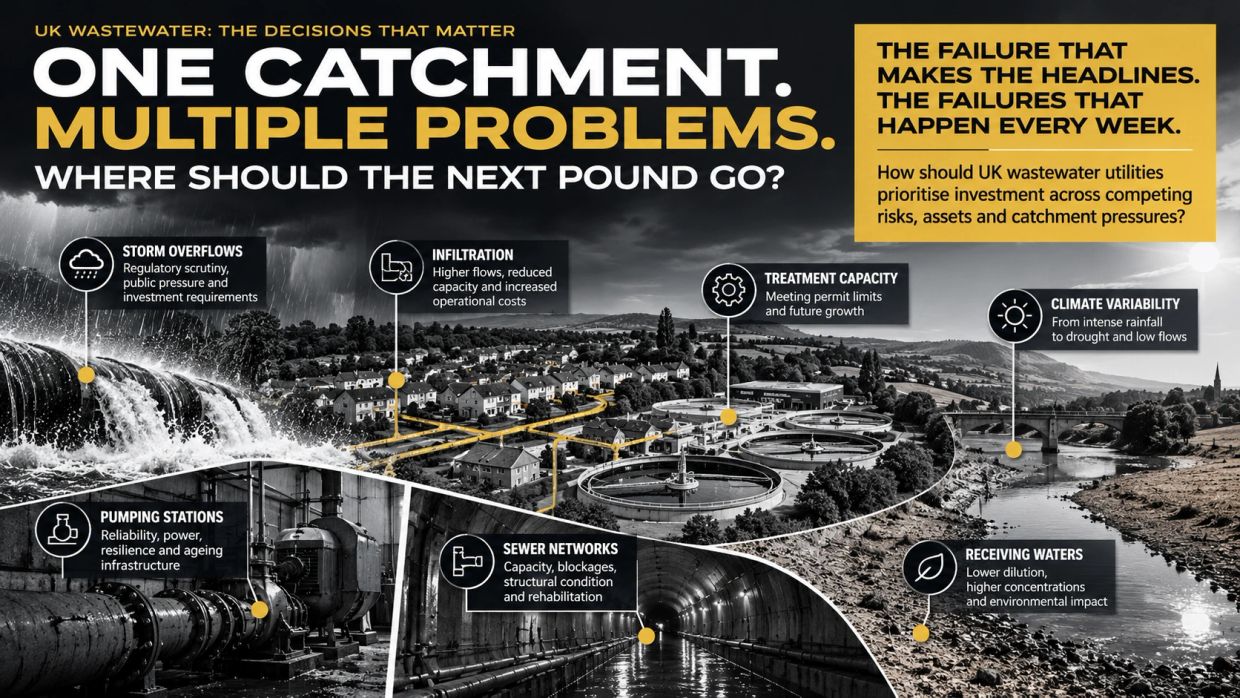
The regulatory bar is rising. The AMP8 delivery challenge is already under way. The real test between now and 2030 is whether wastewater utilities can turn that investment, intelligence and engineering effort into demonstrably better performance.
For example, from 1 January 2026, revised pollution incident classification means that minor incidents can no longer be downgraded through a claim of no environmental impact. In England, monitored dry-day spills are now included in pollution incident reporting, while the Environment Agency's revised Environmental Performance Assessment places greater emphasis on the reliability of storm overflow monitoring data.
Consider the additional background decisions facing a typical wastewater utility.
- A rising main that has never failed but could cause a catastrophic pollution incident
- A pumping station that trips every month, consuming maintenance resources and creating repeated operational risks
- A sewer network losing hydraulic capacity to groundwater infiltration
- A treatment works that remains compliant, but only because operators are constantly intervening to keep it that way
- And a catchment where more intense rainfall, prolonged wet weather and periods of drought are changing the conditions under which the infrastructure must perform
All legitimate problems. All competing for investment, engineering resources and operational attention.
So where should the next pound go?
Should a utility prioritise the rare but potentially catastrophic failure, the smaller incidents that recur every week, or an intervention capable of addressing both?
When should repeated maintenance trigger rehabilitation or replacement? How much hydraulic capacity can realistically be recovered from existing infrastructure? Which operational controls and safeguards are essential to preventing serious pollution incidents?
And critically, how can utilities demonstrate that the money being spent is delivering measurable improvements rather than simply more infrastructure, more monitoring and more reports?
How The Congress Will Address These Challenges
The Wastewater Performance & Resilience Congress 2026 has been developed around precisely these kinds of decisions.
The first part of the programme examines the decisions that determine where investment goes and whether it delivers.
How should utilities reassess AMP8 priorities as new evidence emerges? How do they compare catastrophic risks with recurring asset failures? What makes an intervention deliverable, and how can improvements be measured convincingly across different weather and operating conditions?
The programme then moves into the practical realities of improving asset reliability and preventing failure.
Treatment works, pumping stations, rising mains, sewers, storm overflows and infiltration are examined through real utility experience, including the use of monitoring, asset intelligence, predictive maintenance, operational safeguards, rehabilitation and capacity recovery.
The question is not simply which technologies or engineering solutions are available.
It is what works, under which conditions, what it costs, what difference it makes and whether that improvement can be repeated across thousands of assets and multiple catchments.
Importantly, the agenda also examines how utilities can turn better monitoring and reporting into earlier interventions, fewer incidents and more reliable operations — rather than simply becoming better at identifying and recording problems.
Through utility-led case studies, extended panel discussions and interactive Q&A, delegates will be able to compare approaches, challenge assumptions and explore the practical lessons behind different investment and operational decisions.