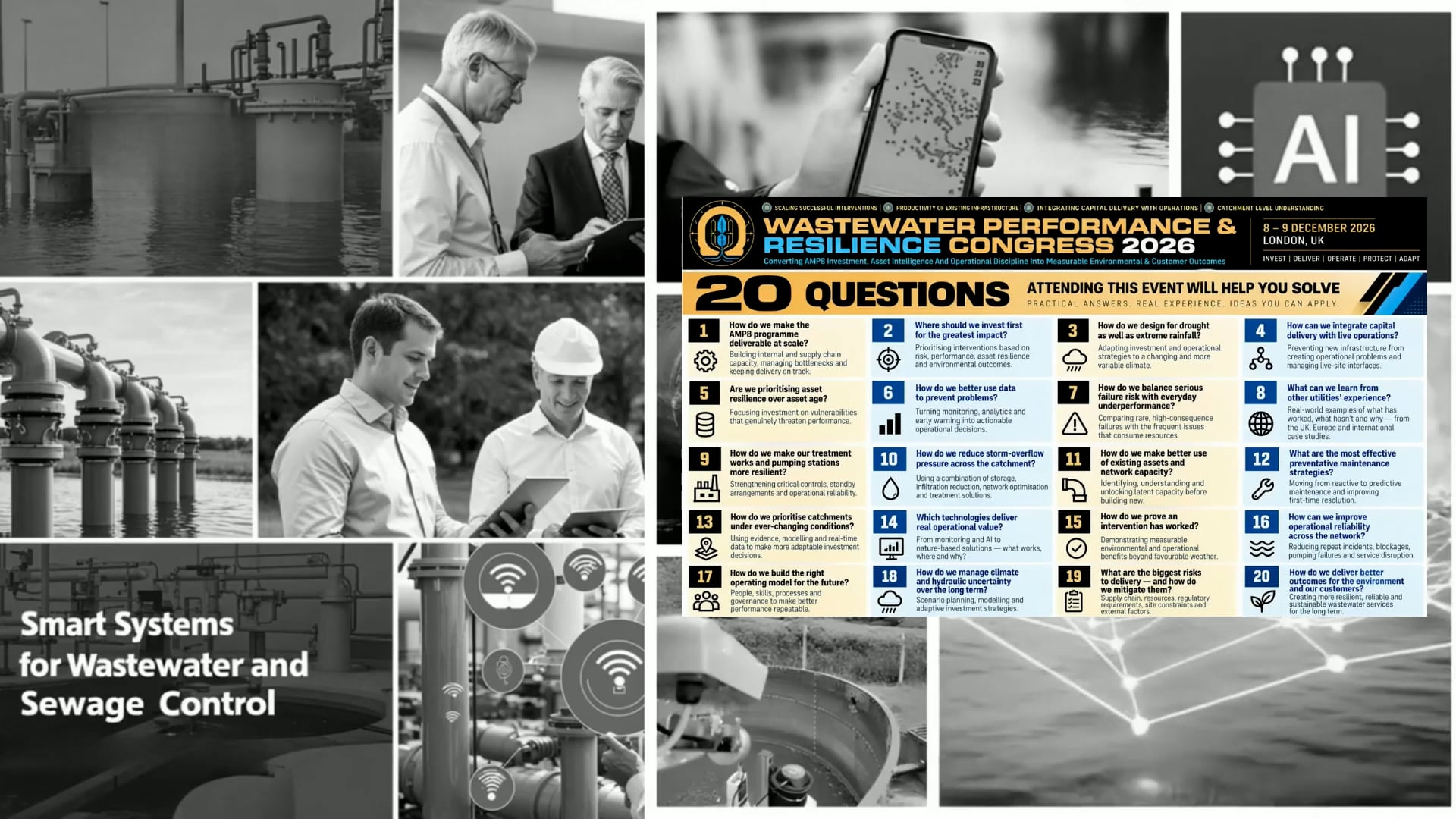
What Will Genuinely Better Wastewater Performance Look Like Between 2027-2030 — And What Will It Take To Deliver It Consistently Across Thousands Of Assets, Multiple Catchments And Increasingly Unpredictable Operating Conditions?
Wastewater companies face a challenge that goes beyond making the right investment decisions. The conditions in which wastewater networks, treatment works and associated infrastructure must operate are changing, while expectations for environmental performance, asset reliability and regulatory compliance continue to rise.
More intense rainfall can overwhelm available storage and treatment capacity. Prolonged wet weather can leave networks saturated, while infiltration consumes valuable hydraulic capacity without a single additional customer connection. At the other extreme, drought and sustained low flows create different pressures: higher pollutant concentrations, reduced dilution and changing hydraulic and biological conditions that can affect treatment performance.
The challenge is not simply to invest in more infrastructure. It is to determine which interventions will make the greatest difference, how to deliver them consistently across entire wastewater systems, and how to prove that the improvements are real.
The Wastewater Performance & Resilience Congress 2026 brings these interconnected challenges together across two days, examining the strategic, operational and technical decisions that determine whether wastewater systems become more dependable, resilient and efficient.
The Investment Question Has Changed: From “What Can We Build?” To “What Improvement Will This Actually Deliver?”
With AMP8 programmes under way, wastewater utilities must decide how best to combine capital investment, operational improvements, smarter monitoring, preventative maintenance and better use of existing infrastructure.
What works in one catchment may not work in another. The real question is which combination of interventions will deliver the greatest improvement under particular hydraulic conditions, asset constraints and risk profiles — and whether the evidence is strong enough to justify the decision.
How do utilities also prevent the major pollution incidents they can no longer afford to experience, while systematically eliminating the smaller recurring failures, inefficiencies and asset weaknesses that undermine everyday performance?
And how can they move beyond reactive maintenance and isolated improvement projects towards more predictable, preventative and consistently reliable operations?
Connecting Investment, Asset Intelligence And Practical Delivery To Better Wastewater Performance At Scale
The congress is deliberately strategic, delivery-focused and technically specific, bringing together wastewater utility case histories, engineering experience and practical lessons from implementation.
The programme begins with investment priorities, AMP8 delivery and system-wide resilience, before examining how better risk assessment, monitoring, asset intelligence, predictive maintenance and organisational capability can translate into earlier interventions and more effective operational decisions.
It then moves into the practical challenges of improving performance across treatment works, pumping stations, rising mains, sewers and storm overflow systems — including preventing serious pollution incidents, addressing recurring asset failures, managing infiltration, recovering hydraulic capacity, optimising existing infrastructure and determining when rehabilitation offers better value than replacement.
The emphasis throughout is on closing the gaps between investment, delivery, asset reliability and measurable operational improvement. Better information must lead to better decisions. Capital investment must translate into improved performance. And interventions that work on individual assets must be capable of being sustained and, where appropriate, repeated across wider networks and catchments.
What Should Wastewater Utilities Be Doing Differently During The Remainder Of AMP8?
Across the two days, delegates will compare approaches, challenge assumptions and examine what can realistically be applied across different wastewater systems.
When should utilities rehabilitate rather than replace? What level of redundancy is proportionate to the risk? When should repeated reactive maintenance trigger a capital decision? How much spare hydraulic capacity can genuinely be recovered? Which indicators provide sufficiently early warning of serious pollution incidents to prevent them? How should nature-based wastewater assets be maintained and funded over 25 years? And how do we demonstrate that a claimed performance improvement was caused by an intervention rather than favourable weather?
Through practical utility case studies, extended panel discussions and interactive roundtables, the congress provides an opportunity to examine not just what has worked, but why it worked, under which conditions, what it cost, what could have been done differently and whether the results can be replicated at scale.
Ultimately, the Wastewater Performance & Resilience Congress 2026 is about turning investment and operational improvement into more dependable wastewater performance — preventing avoidable failures, recovering value from existing assets and delivering measurable improvements that can be sustained across entire systems.
We spent the best part of three weeks speaking directly to wastewater utilities to research and develop this event, and we certainly didn't cut any corners.
Our research extended well beyond England, Wales and Scotland. We also spoke to utilities across Northern and Eastern Europe, Greece and further afield, including the Middle East, to build a broader picture of the challenges facing the sector, the approaches being taken and, importantly, what utilities can learn from one another.
Perhaps unsurprisingly, we found considerable interest in the UK experience, particularly among Northern European utilities, but also from countries such as Greece and across the Middle East.
And there's a good reason for that. The UK wastewater sector is operating under an exceptionally demanding regulatory regime, with intense scrutiny of environmental performance, investment decisions and delivery. The eyes of the world are on what happens next.
HEAR FIRST-HAND HOW UTILITIES ARE:
Turning capital into performance: delivering AMP8 at scale without the programme overwhelming delivery capacity or destabilising live operations.
Choosing the right interventions: prioritising investment by risk, consequence and environmental outcome, and choosing the right mix across a whole catchment rather than asset by asset.
Preventing the incident they cannot afford: controlling serious pollution at treatment works, pumping stations and rising mains.
Ending the failures that keep happening: eliminating the repeat blockages, pump trips and process upsets that cumulatively drag performance down.
Getting more from what they already own: recovering hydraulic headroom through infiltration reduction, surface water removal, active control and better use of storage before pouring more concrete.
Proving it worked: separating the effect of an intervention from the effect of the weather, and knowing when the evidence is strong enough to claim the benefit.