

TEN REASONS SOLUTION PROVIDERS SHOULD CONSIDER THIS CONGRESS
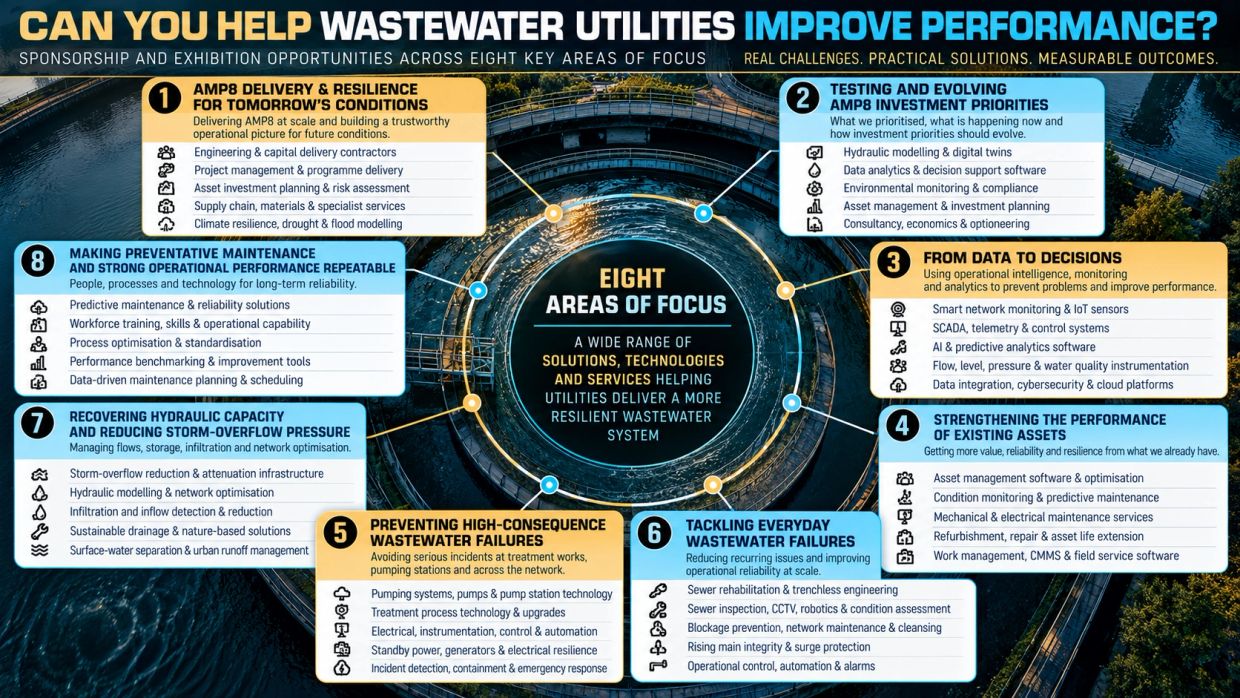
1. The programme is structured around live utility decisions
The agenda asks where AMP8 funding should go next, what to rehabilitate, where to add headroom, how to prevent repeat incidents, which controls are critical and what evidence proves success. These are the decisions that create qualified demand for design, technology, construction and operations support.
2. It links senior capital decisions with the people who operate the assets
It is unusual for commercial conversations to connect delivery directors, asset specialists, control-room intelligence, wastewater operators and catchment managers in a single narrative. Here, the supplier can understand not just who specifies a solution but who must make it work, accept it and maintain it.
3. It tackles the limits of current approaches as well as their successes
An intervention that fails under prolonged rainfall, an unreliable alarm system or a sensor rollout with unsustainable OPEX is commercially useful learning. It reveals where operators are looking for better alternatives and where a more robust supplier approach may be valuable.
4. It covers both high-consequence incidents and routine operational losses
Serious pollution prevention creates demand for resilience, assurance, containment, monitoring and critical engineering. Everyday reliability creates demand for maintenance productivity, sewer rehabilitation, pump and process reliability, diagnostics and lasting defect removal. Partners can focus on the performance problem they genuinely solve.
5. It puts AMP8 delivery constraints on the table
Utilities need engineering throughput, safer live-site working, faster optioneering, standardised packages, commissioning capability and dependable supply chains. Suppliers who can help deliver at scale, rather than simply offer a novel component, have a relevant and timely story.
6. It examines the whole catchment rather than a single asset sale
Capacity can be gained through many competing and complementary interventions. Suppliers who work across surveys, infiltration reduction, active control, pumping, storm storage, treatment and sustainable drainage can take part in the wider value discussion instead of being confined to one product aisle.
7. It is about whole-life performance rather than the commissioning photograph
The conference asks whether installed infrastructure remains operable, maintainable and resilient. This favours providers able to demonstrate lifecycle evidence, service capability, interoperability, training, spare-parts strategy, maintainability and measurable operating benefit.
8. It offers a credible setting for international transfer of experience
Utilities in other markets face many of the same engineering constraints, even under different regulation. Suppliers with UK, European and wider international experience can discuss which practices scale, which depend on local conditions and where proven methods may transfer.
9. The discussion format is deliberately more demanding than a sales pitch
Curated Q&A and roundtables are designed to question assumptions. For suppliers with strong evidence, this is an advantage: technical credibility and candid discussion can differentiate them more effectively than generic claims of innovation, efficiency or transformation.
10. It helps commercial teams understand what evidence buyers now need
Buyers may ask about avoided incidents, recovered capacity, reduced reactive maintenance, operational lead time, environmental benefit, weather normalisation and long-term OPEX. Understanding those proof points is useful both for business development now and for shaping the next generation of solution propositions.